
TL;DR
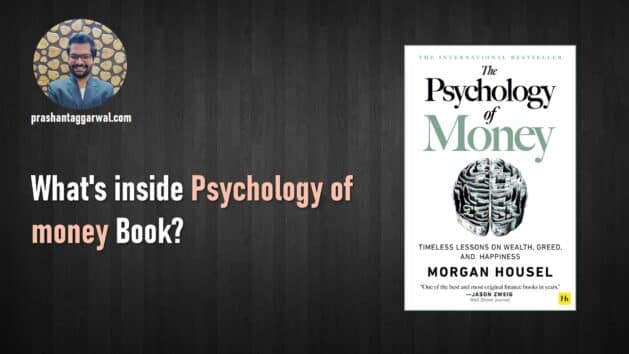
The Psychology of Money by Morgan Housel is the best personal finance book I’ve read — not because it teaches you what to invest in, but because it explains why intelligent people consistently make terrible financial decisions. As an active trader, I found it uncomfortable in the best way. These are the 12 ideas that stayed with me.
Most personal finance books tell you what to do: save this percentage, invest in these assets, follow this formula. Morgan Housel’s The Psychology of Money does something more useful — it explains why we don’t do what we know we should, and why financial outcomes are far more about behaviour than knowledge.
I’ve been actively investing and trading for years. I know the theory. I’ve still made the behavioural errors Housel describes. That’s the point of the book — knowing about cognitive biases doesn’t make you immune to them. But understanding the specific ways money and psychology interact changes how you approach decisions at the margin.
1. No one is crazy — everyone’s financial behaviour makes sense in their own context
People who grew up during the Great Depression developed different risk tolerances from people who grew up during the 1990s bull market. Neither is irrational — they’re responding to their own experience. Before judging anyone’s financial decisions (including your own), understand the experience that shaped the behaviour.
2. Luck and risk are siblings — and we systematically ignore both
Housel’s most important structural argument: outcomes in financial life are not purely a function of decisions. Luck plays a significant role, as does the risk of low-probability events. We attribute successful outcomes to skill and failed outcomes to bad luck — which produces overconfidence in our models and underestimation of how badly things can go.
3. Enough — the most underrated financial concept
The inability to define “enough” drives some of the worst financial outcomes: excessive risk-taking after already achieving financial security, comparison-driven spending, and the unhappiness of perpetually moving goalposts. Knowing your enough number — and being satisfied by it — is harder and more valuable than knowing how to invest.
4. Compounding is counterintuitive — and that’s why it’s underused
Warren Buffett’s net worth is overwhelmingly a function of time, not returns. He started investing at 10 and has never stopped. Most of his wealth was accumulated after his 50th birthday. The math of compounding is simple but the human psychology of patience required to let it work is genuinely difficult.
5. Getting wealthy and staying wealthy require different skills
Getting wealthy requires risk-taking, optimism, and aggressive action. Staying wealthy requires paranoia, humility, and the willingness to reduce exposure. People who conflate the two — who continue taking large risks after achieving financial security — frequently give back what they’ve built.
6. Tails drive everything
In investing, a small number of decisions or positions drive the vast majority of outcomes. Most venture capital returns come from a handful of investments. Most stock market returns come from a small percentage of stocks. The implication: you can be wrong about most things and still win, as long as you’re right about a few important ones — and you stay in the game long enough to let them play out.
7. Freedom is the highest dividend money pays
Housel’s most memorable line: the highest form of wealth is the ability to wake up and do whatever you want. Not luxury — autonomy. The ability to control your time is more valuable, and less expensive to achieve, than most people realise. This reframes the purpose of saving and investing — it’s not primarily about possessions, it’s about options.
8. Man in the car paradox
Nobody looks at someone driving an expensive car and thinks about the driver. They think about themselves in the car. Nobody is paying as much attention to your wealth signals as you are. Status spending is largely wasted on an audience that isn’t actually watching.
9. Wealth is what you don’t see
Real wealth is assets not spent. The person with the visible luxury lifestyle may have far less net worth than the person living modestly and compounding quietly. This distinction — between wealth and income, between net worth and spending rate — is consistently confused in public discourse about money.
10. Save without a specific goal
Housel argues for saving beyond specific goals — a car fund, a house deposit, an emergency fund. The most valuable savings are flexible savings that give you options you can’t anticipate. The future will present opportunities and problems you haven’t predicted. Unearmarked savings are the raw material for responding to both.
11. Reasonable beats rational
A perfectly rational investment strategy that you can’t emotionally sustain is worse than a slightly suboptimal strategy you’ll actually stick to. The best investment strategy for you is the one you’ll follow for decades. Accounting for your own psychology is not weakness — it’s calibration.
12. History is not a reliable guide to future surprises
The most important financial events are the ones nobody saw coming — because if everyone had seen them coming, they’d have been priced in. Historical data tells you what has happened, not what will happen. The next major financial disruption will look different from all previous ones.
My honest take
This is the best short personal finance book I’ve read. Housel writes well, thinks clearly, and has the humility to apply his frameworks to his own decision-making rather than just prescribing them. If you read one book about money this year, read this one.
For the deeper cognitive science behind why these behavioural errors happen, the Thinking Fast and Slow summary is the companion read. And if you want to understand the structural decisions behind building wealth — what quadrant you should be operating from — the Cashflow Quadrant summary covers that angle.
About the author
Prashant Aggarwal is an active stock trader and Brand Manager based in New Delhi. He writes about investing, marketing and decision-making at prashantaggarwal.com