
TL;DR
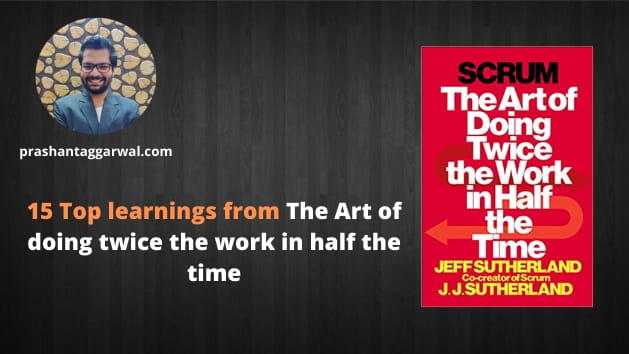
Scrum by Jeff Sutherland is about doing complex work faster by working in short sprints, reviewing constantly, and cutting everything that doesn’t move the needle. I’ve applied this framework to brand campaigns, project planning and my own daily work. These are the 15 lessons that are actually worth knowing.
Most productivity frameworks are designed for individual output. Scrum is designed for teams working on complex problems where requirements change, outcomes are uncertain, and traditional planning fails. That describes almost every marketing project I’ve ever worked on.
Jeff Sutherland co-created Scrum for software development, but its principles apply well beyond code. After reading this book, I restructured how I approach brand campaign planning — and the difference was noticeable. Here’s what actually mattered.
1. Waterfall planning is built for failure
Traditional project management assumes you can plan everything upfront, execute linearly, and deliver on time. Sutherland’s argument is that this approach fails consistently on complex projects because requirements change, unknowns emerge, and the plan becomes obsolete before execution begins. Most marketing projects I’ve seen fail in exactly this way — over-planned at the start, under-resourced in the middle, scrambled at the end.
2. Work in sprints, not long timelines
A sprint is a fixed, short work period — usually 1-4 weeks — at the end of which you have a working, reviewable output. Instead of planning 6 months and delivering once, you plan 2 weeks and deliver repeatedly. The feedback loops tighten dramatically. Errors get caught early. This one principle alone changes how teams work.
3. The daily standup has one purpose: remove blockers
Three questions. What did you do yesterday? What are you doing today? What’s blocking you? That’s it. Fifteen minutes maximum. The standup is not a status report — it’s a blocker identification mechanism. Every minute spent on status reporting in a standup is wasted.
4. Velocity is the only productivity metric that matters
Sutherland measures team output in “story points” — units of work complexity completed per sprint. Velocity is how many story points a team completes consistently. The insight: once you know your velocity, you can predict delivery reliably. Without it, every timeline estimate is fiction.
5. Multitasking destroys output — it doesn’t enhance it
Sutherland cites research showing that switching between tasks has a significant cognitive cost. Working on 3 things simultaneously doesn’t produce 3x the output — it produces roughly 40% of the output of focused single-task work. One thing at a time, completely, before moving to the next.
6. Prioritise the backlog ruthlessly
The product backlog is the list of everything that needs doing. The key discipline is ruthless prioritisation — only the top items get worked on, and the list is constantly re-ranked based on value. In marketing terms: not everything on the brand plan needs to happen. What moves the most important needle this sprint?
7. Definition of Done eliminates ambiguity
Every task needs a clear, agreed definition of what “done” means before work begins. Without this, work expands indefinitely, quality varies, and handoffs break down. In my experience this is one of the most underused practices in marketing teams — “done” is often vague until someone is unhappy with the output.
8. Inspect and adapt — every sprint, without exception
At the end of every sprint, hold a retrospective: what went well, what didn’t, what will you change next sprint. The discipline is doing this even when the sprint went fine. Continuous improvement is not a crisis response — it’s a regular cadence.
9. Technical debt in projects works exactly like financial debt
Every shortcut you take — the quick fix, the process skipped, the documentation deferred — becomes debt that must be paid back later, usually at a worse time and with interest. This maps directly onto what Zero to Scale argues about business building. Shortcuts compound negatively.
10. Happiness drives performance, not the other way around
Sutherland references research showing that happy teams are significantly more productive than unhappy ones — and that happiness is measurable and manageable. The implication for team leaders is that morale is not soft — it’s a performance variable with measurable output impact.
11. The team must own the process
Top-down process imposition kills Scrum. The team decides how to work, how to structure sprints, how to run retrospectives. Management provides the goal and removes obstacles. Micro-management and Scrum are incompatible.
12. Waste is the enemy — identify and eliminate it constantly
Drawn from lean manufacturing principles: identify every activity that doesn’t add value to the final output and eliminate it. In marketing this includes meetings that produce no decisions, approval chains that add no quality, and reporting that nobody acts on.
13. Heroics are a failure mode, not a success story
When a project requires someone to work nights and weekends to deliver, that’s not a success — it’s a system failure. Sustainable pace is a design principle. Teams that regularly require heroics are teams with broken planning, not teams with impressive work ethic.
14. Cross-functional teams outperform specialist silos
A team with all the skills needed to complete work from start to finish outperforms a chain of specialist handoffs. In marketing this argues for integrated teams over siloed functions — strategy, creative, data, and execution in the same room.
15. The Scrum Master’s job is to remove obstacles, not manage people
The Scrum Master is a servant leader — not a project manager, not a boss. Their only job is to ensure the team can work without friction. This role is consistently misunderstood and misapplied in organisations that adopt Scrum without understanding its philosophy.
My honest take
Scrum is most powerful for software and product teams. Applying it wholesale to marketing doesn’t always work — campaign timelines, agency dependencies, and approval processes don’t always fit neatly into 2-week sprints.
But the underlying principles — short feedback loops, ruthless prioritisation, defining done, eliminating waste, sustainable pace — are universally applicable. I’ve taken these principles into brand planning cycles and they’ve made my work more focused and less chaotic. That’s worth the read.
If the project management angle interests you, my take on Getting Things Done covers the individual productivity side of the same problem. And the structural thinking in Zero to Scale applies the same “build correctly from the start” logic to business building.
About the author
Prashant Aggarwal is a Brand Manager with 12+ years in consumer goods. He writes about marketing, decision-making and investing at prashantaggarwal.com