
TL;DR
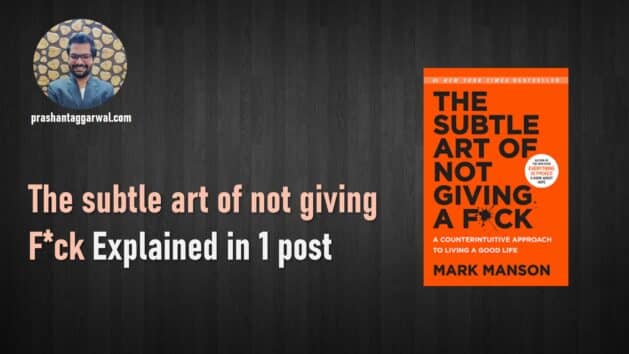
The Subtle Art of Not Giving a F*ck by Mark Manson is a genuinely useful book dressed in a provocative package. The core argument — that you have a finite number of f*cks to give and most people give them to the wrong things — is more philosophically serious than the title suggests. Here’s what’s worth taking from it.
The title is designed to make you think this is a book about caring less. It isn’t. It’s a book about caring more selectively — about understanding that attention and emotional energy are finite resources and that most people exhaust them on things that don’t actually matter to them.
Manson is drawing on Stoic philosophy and acceptance-based psychology, but writing for an audience that would never pick up Marcus Aurelius. That’s not a criticism — it’s a genuine service. Here’s what he gets right.
The feedback loop from hell
Manson opens with what he calls the “feedback loop from hell” — the anxiety about anxiety. You feel bad about something, then you feel bad about feeling bad, which makes the original feeling worse. The solution is not to stop feeling bad — it’s to stop judging the feeling as a problem that needs to be solved.
This is not a new idea — it’s the core of acceptance-based therapies. But Manson states it accessibly and applies it practically.
You always choose your problems
Manson’s most important argument: happiness is not the absence of problems. It’s having problems you find meaningful. The question is not “how do I get rid of my problems” but “what problems am I willing to have?” This reframe is genuinely useful. Every goal produces its own problems — the question is whether those problems are worth it to you.
The value of negative experiences
Pursuing positive experiences is itself a form of negative experience — it creates anxiety, comparison, and the constant sense of not having arrived. Accepting negative experiences — difficulty, failure, discomfort — as inherent to a meaningful life reduces the meta-suffering that comes from resisting them.
You are not special — and that’s fine
Manson takes aim at the “everyone is special and exceptional” cultural narrative. The problem with exceptionalism as an expectation: it makes ordinary, meaningful, and satisfying lives feel like failure. Most good lives are ordinary lives lived well. That’s not a consolation prize — it’s the actual prize.
Responsibility vs fault
One of the clearer distinctions in the book: fault and responsibility are different things. Many situations are not your fault. They are, however, your responsibility — in the sense that you’re the only person who can determine how you respond to them. Conflating the two produces victimhood. Separating them produces agency.
The do something principle
Manson’s practical antidote to paralysis: action produces motivation, not the other way around. Don’t wait until you feel motivated to start. Start badly. Action → results → motivation → better action. This maps onto Morita therapy’s insight from the Ikigai book, and onto the research on habits — behaviour precedes identity.
My honest take
The book is better than its reputation in both directions. It’s not as shallow as critics claim — the philosophical underpinning is real. It’s not as original as fans claim — most of the ideas are variations on Stoicism and acceptance-based psychology. But it’s well-written, honest about its author’s own failures, and consistently readable.
Worth reading if you haven’t. If you have, the ideas hold up better on reflection than they might seem at first pass.
The “choose your problems” framework connects well to the Ikigai concept of daily purpose — both are essentially asking what you’re willing to suffer for. My Ikigai review covers that angle. And for the deeper psychology of why we resist negative experience, the Thinking Fast and Slow summary explains the loss aversion and negativity bias mechanisms underneath.
About the author
Prashant Aggarwal is a Brand Manager with 12+ years in consumer goods. He writes about marketing, decision-making and investing at prashantaggarwal.com